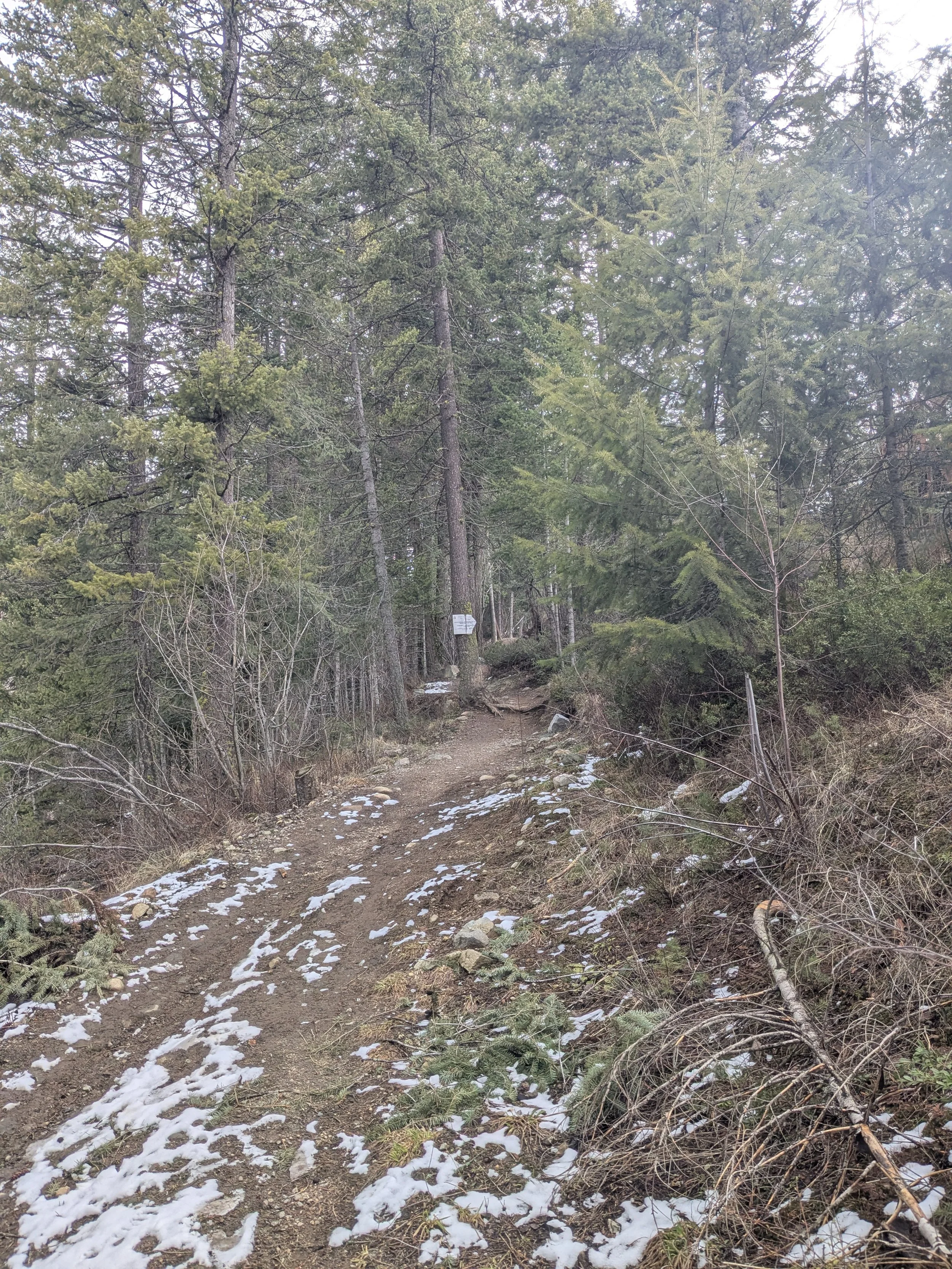
At the end of our street is the opening to a trail you can take up or down. You have to look first: a mountain bike might be flying toward you. Going downward, I slipped and hit my head earlier this winter. I spent months in jiu jitsu learning how to slap the floor and keep my head elevated when I fell, and demonstrated this skill by sliding on a banana peel last year in my musical “Good Dog,” but here I was at the mercy of the trail. Nothing came of it; no time off work. I’m finally resolving my two-year shoulder injury also incurred from slipping and falling, this time trying to cross the hill, a snowboard in hand. I’ve never done the bobsled course down the street that brackets the other side of our road, but I watch every year, hoping for crashes. I don’t want anyone hurt, but after watching homemade carts zip by one after the other it becomes no different from watching cars. I remember my falls, not my walks.
The Centre Star Gulch trail starts just above Esling Park, which marks the end of the bobsled course, and where four actors first performed “The Injury Play” at an off-festival to the 2019 Rossland Winter Carnival. I wrote the play by interviewing a dozen people in town who injured themselves doing extreme sports, though actually one confessed she was doing laundry. As I suspected, their stories followed a similar arc, and I used their words to build a short piece of verbatim theatre I later workshopped with different actors as “The Mountain.” The trail offers several switchbacks on its way up to the arena, though a cyclist or hiker that wanted to could avoid them and go straight up or down. To continue on to the next part of the trail, you need to cross through the arena parking lot, where I once saw a man tossing a ball to his dog. He threw it up to the peak of the arena roof and the dog positioned himself to catch it as it rolled back toward them.
The second opening to the trail is next to the city works yard that, in the winter, deploys snow plows and in the spring, cleans up the gravel they sprayed if you collect it in a pile. I always look into the depths of the gulch as we walk this trail. I suppose it’s the instinct that got people mining in the first place, and from which remains a deep fissure that once needed a railroad bridge to cross it. Along our basement ceiling is an original beam from this bridge, built like our house in the 1890s—our home supposedly by twelve Frenchmen in a weekend.
We’re putting our home on the market next week. In our first years living here, I dreamed of bears at the door, cougars circling, and basements with doors that led to new rooms. I haven’t had those dreams for a while. “I used to think each house was a person” says Ellie in the last of the Tenant stories recorded here. I’m not sure what she thinks now. In fact, I think that character might be dead. The gulch is here as a remnant of the mining history of this town. The mines are now shut: they got all they needed and left. But the legacy remains alive in the refinery in Trail and the new proposed mining operation along another mountain bike route, the Seven Summits. A group has organised in town to protect the site called Record Ridge by demanding an environmental review. Two weeks ago, hundreds of people showed up in protest at the Rossland Courthouse, and the injunction against the mining company was granted. A town built on mining has turned against it in favour of mountain biking. Of course we have: we want the trails, not the gulch.
The third part of the trail continues past our house and around a severe switchback I didn’t imagine anyone could possibly ride on their bike. If you missed the turn, you’d go straight off into the abyss. Last fall, having moutain biked more than a handful of times that summer, I was able to imagine cornering it. Falling off the abyss, I reasoned, could happen anywhere. Above this is my favourite part of the trail. With condos to the left and large homes to the right, the path is nicely graded, dipping only once, and with plenty of trees and shrubs. I’m always happiest on this last stretch, whether I start or end here. It runs horizontal to our street, curling toward the bobsled start, where people can cross the road and meet the Centennial parking lot or, if they’re dead from one hundred years ago, cross the bridge and go to work.